
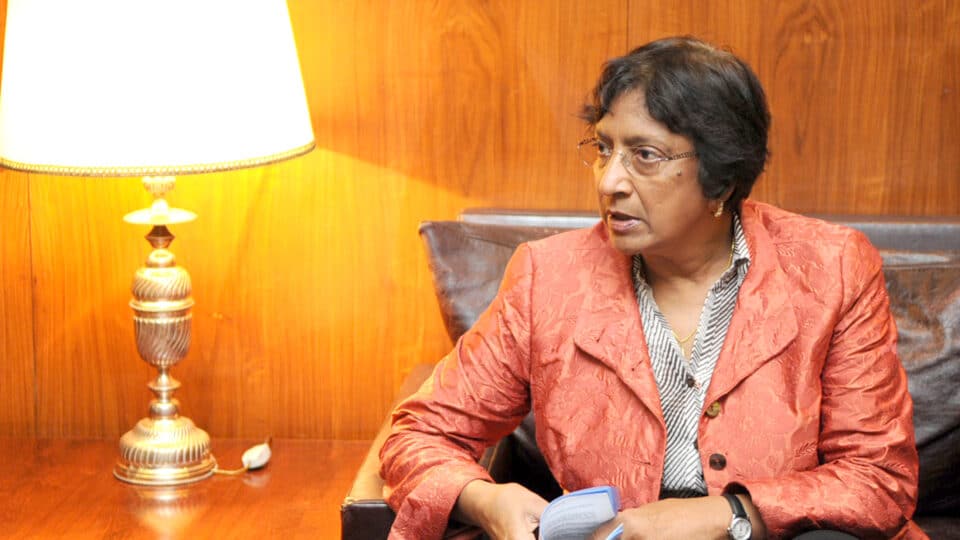
In an announcement made on Friday, 9 October, the 2026 Nobel Peace Prize was awarded to South African jurist Navanethem “Navi” Pillay for her contribution to promoting peace and international law. The announcement by the Norwegian Nobel Committee highlights a career built in courtrooms, United Nations institutions and the defence of people whose rights have been violated.
The choice raises a relevant question at a tense moment for international relations: can the application of law provide a path to peace, even when rulings or investigations are politically contested? The Committee answered by recognising Pillay’s long-standing legal work, rather than rewarding a single diplomatic negotiation.
Who is Navi Pillay, the 2026 Nobel Peace Prize laureate?
Born in 1941 in Durban, South Africa, Navanethem Pillay grew up under apartheid, a system that institutionalised racial segregation and discrimination. From a family of Tamil Indian origin, she chose the legal profession at a time when social and institutional barriers were strong, especially for women.
In 1967, she opened her own law practice and represented people persecuted for political reasons, including supporters of the anti-apartheid struggle. Her work is also associated with defending the rights of Nelson Mandela and other political prisoners. Following advanced studies in the United States, she earned a Doctor of Juridical Science degree from Harvard in 1988.
In 1995, after South Africa’s democratic transition, Pillay was appointed a judge of the High Court of South Africa. Her rise in the judiciary would later continue beyond the country’s borders.
From apartheid to international criminal tribunals
A central chapter in her career was her work at the International Criminal Tribunal for Rwanda, established to try crimes committed in the context of the 1994 genocide. At this institution, case law strengthened the understanding of sexual violence as a possible instrument of international crimes and of the role of public incitement in committing atrocities.
Later, Navi Pillay became a judge at the International Criminal Court (ICC). The distinction between these bodies is important: criminal tribunals and the ICC deal with the criminal responsibility of individuals, rather than adjudicating the responsibility of states as such. Their proceedings require evidence and are subject to jurisdictional rules, and their operation does not depend on the political popularity of a verdict.
Between 2008 and 2014, Pillay served as the UN High Commissioner for Human Rights. The role involves monitoring violations of fundamental rights and engaging with governments, organisations and victims, without having the powers of a court of law.
Recent work and sensitive international law cases
From 2021 to 2025, Pillay chaired a UN independent international commission of inquiry on the occupied Palestinian territory and Israel. The commission’s conclusions and methods prompted differing reactions: some actors stressed the role of independent investigations, while Israeli officials challenged the allegations and criticised the impartiality of the process. These positions must be distinguished from final decisions by international courts.
The jurist is also involved as an ad hoc judge at the International Court of Justice (ICJ) in the case concerning allegations of genocide against the Rohingya population in Myanmar. The ICJ resolves disputes between states, unlike the ICC, which examines individual criminal responsibility. Neither an investigation nor a claim made by a party automatically amounts to a final judicial conviction.
Her work on such cases explains why the laureate’s name features in sensitive international debates. The 2026 award recognises the jurist’s professional career; it does not turn every position taken by her or by the institutions of which she has been part into universally accepted conclusions.
Why the 2026 Nobel Peace Prize went to Navi Pillay
In its official citation published on 9 October, the Nobel Committee emphasises the defence of the international legal order, combating impunity for war crimes, crimes against humanity and genocide, and the use of courts as instruments of lasting peace.
The message differs from the view that peace is achieved solely by leaders signing agreements. In the logic set out by the Committee, investigations, documentation of violations and the functioning of courts create shared rules that can reduce the scope for arbitrariness. It is an approach to peace through institutions and legal accountability.
The 2026 prize is awarded in the year marking 125 years since the first Nobel Peace Prize was presented. Yet there remains a gap between the historical significance of the moment and the practical impact of the decision: international institutions also need states’ cooperation to implement their decisions.
How the Nobel Peace Prize differs from a political decision
The prize is decided by the Norwegian Nobel Committee, established under the system set out in Alfred Nobel’s will. The distinction does not grant its recipient new office, nor does it have legal effects on proceedings pending before courts.
For this reason, an assessment of Pillay as a laureate must be kept separate from debates over each individual case. Supporters of international law see the choice as a message about the need for legal accountability. Critics of certain investigations continue to challenge interpretations or methodologies. The public can follow the arguments and official documents without confusing the recognition of a career with the resolution of cases.
What follows the 2026 Nobel Peace Prize announcement
The decision of 9 October identifies the laureate. The traditional award ceremony takes place in Oslo in December, while debates over the independence of international legal institutions continue. For readers in Romania, the subject offers an opportunity to understand the differences between the UN, the International Criminal Court, the International Court of Justice and tribunals established for specific conflicts.
The central point of the award: international justice is not an immediate substitute for diplomacy, but it can provide a framework for investigation and accountability when political negotiations do not resolve allegations of atrocities.
For another perspective on the Nobel Prizes, from the world of science, read InfoBuz’s article on optogenetics and controlling neuronal activity with light. The awarded fields are different, but both subjects show how a lasting contribution is recognised.
Official and background sources
- Norwegian Nobel Committee – official award announcement, 9 October 2026.
- Nobel Peace Prize – profile of laureate Navi Pillay.
- United Nations – the laureate’s work and career.
Photo: Antônio Cruz / Agência Brasil / Wikimedia Commons, CC BY. Authentic archive photograph of Navi Pillay, not from the 2026 Nobel ceremony.
InfoBuz editorial research: 9 October 2026. Information concerning legal cases does not amount to final findings of guilt in cases that are still ongoing.


Discuția cititorilor
Ai o opinie sau o întrebare despre acest articol? Spune-ne ce crezi.
Fii primul care deschide discuția.
Te rugăm să păstrezi un limbaj civilizat și să discuți la subiect. Comentariile spam sunt filtrate automat.