
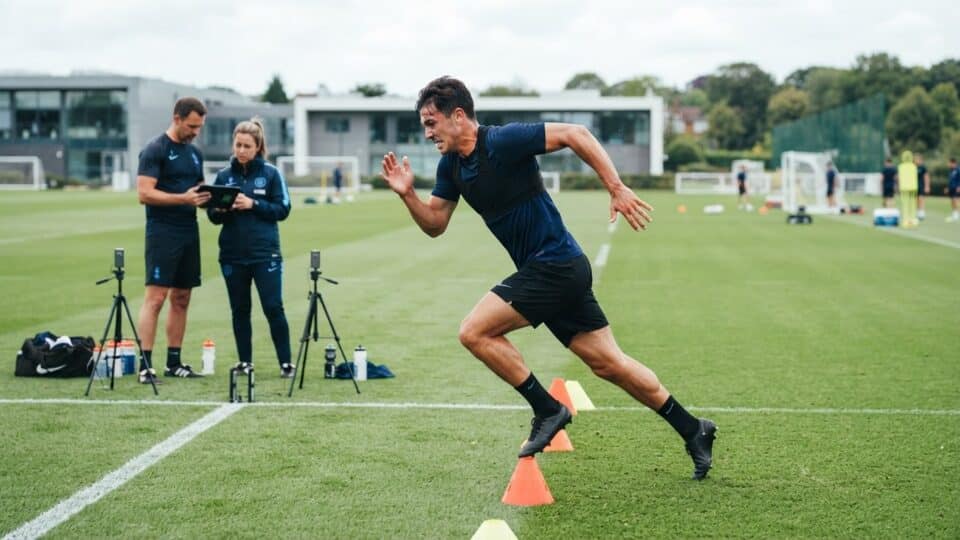
A professional footballer’s physical preparation for 90 minutes does not begin on match day, nor is it simply a matter of running. In modern football, training is planned according to position, playing style, the fixture schedule, individual history, workload in previous matches and the tactical demands posed by the next opponent.
A player must be able to accelerate, brake, change direction, jump, sprint, contest duels, repeat high-intensity efforts and make technical decisions while fatigued. That is why staff do not look only at “how many kilometres a player ran”, but also at high-speed running, the number of accelerations, the intensity of the effort and how well the player recovers.
Why 90 minutes differ from continuous running
Football is an intermittent sport. A player alternates between:
- walking;
- light jogging;
- running at moderate intensity;
- high-speed running;
- sprinting;
- braking;
- changes of direction;
- jumping;
- contact and duels.
UEFA says in its physical analysis of EURO 2024 that sprints account for only a small part of total distance, but often occur in decisive actions and are among the most demanding physical actions in the game.
A match can therefore contain relatively quiet periods, followed by a few seconds in which a player must produce near-instant maximum acceleration.
Why “10 kilometres per match” tells only part of the story
Total distance is a useful statistic, but an insufficient one.
A midfielder may cover a very large total distance, while a winger or full-back may perform more actions at high speeds.
UEFA stresses that the differences between positions become more evident at high speeds. Two matches with the same total distance can therefore place entirely different demands on players.
A player who covers 10.5km with many sprints, changes of direction and transitions may accumulate a different workload from one who covers the same distance at a more even pace.
Acceleration is often more important than top speed
Most sprints in a match are not 50–60-metre runs.
Many decisive actions take place over short distances:
- running into space;
- pressing;
- moving off the ball;
- defensive recovery runs;
- attacking a loose ball after a clearance;
- breaking free from marking.
Speed preparation therefore includes both short sprints for acceleration and controlled exposure to high speeds to develop maximum speed and sprint tolerance.
Why maximum sprints must be trained, not avoided
It may seem logical to reduce sprinting in training to protect players, but a footballer who is not exposed to high speeds in a controlled way may be unprepared for the very highest-intensity actions in a match.
UEFA says preparation must account for the game’s peak demands.
Staff can therefore schedule controlled sprints, with adequate recovery, on appropriate days of the week.
The aim is not fatigue for its own sake, but adaptation.
The weekly microcycle
In football, the week between two matches is often organised as a microcycle.
Days are sometimes designated in relation to the match:
- MD = Match Day;
- MD-1 = one day before the match;
- MD-2 = two days before the match;
- MD+1 = the first day after the match.
The structure varies from club to club and depends on the schedule, but the principle is the same: demanding training is not placed at random.
MD+1: recovery starts immediately after the match
For starters who played many minutes, the day after a match is generally focused on recovery.
This may involve:
- light movement;
- cycling;
- mobility work;
- individual exercises;
- physiotherapy treatment;
- nutrition and hydration;
- monitoring of pain and fatigue.
Players who did not play, or played only limited minutes, may instead be given a more intense session to make up for the lack of match workload.
Why substitutes may have a hard session after the match
A player who has been on the bench does not receive the same workload as the starters.
If staff treated the entire squad identically, substitutes could gradually accumulate a deficit in physical preparation.
For that reason, after the match or the following day they may do:
- small-sided games;
- intensive running;
- sprints;
- strength work;
- individualised exercises.
MD-4 and MD-3: the days for heavier work
If there is a full week between matches, the middle days of the microcycle generally allow for the most significant physical stimulus.
These may include:
- high-intensity games;
- small-sided games;
- transition drills;
- gym-based strength work;
- accelerations and sprints;
- aerobic and anaerobic work integrated into ball exercises.
Volume and intensity are adjusted individually.
Why small-sided games are so widely used
Small-sided games make it possible to combine physical preparation with tactical and technical decision-making.
On a small pitch, a player has:
- more touches of the ball;
- more duels;
- more accelerations and braking actions;
- short breaks;
- high decision-making pressure.
But they do not perfectly reproduce every demand of a match.
A small space, for example, can produce many accelerations while limiting the opportunity to reach maximum speed. Staff may therefore combine small-sided games with drills in larger spaces and dedicated sprinting.
MD-2: intensity starts to fall
Two days before the match, the aim is generally to maintain speed and quality without building up major fatigue.
The session may include:
- tactical work;
- set pieces;
- controlled-intensity games;
- short accelerations;
- individual work.
At this stage, staff try to reduce volume while retaining enough intensity to prevent players from going into the match feeling flat.
MD-1: activation, not fatigue
Training the day before the match is generally shorter.
The focus may be on:
- neuromuscular activation;
- possession exercises;
- set pieces;
- rehearsing tactical principles;
- a few fast actions;
- confidence and freshness.
The aim is not to “build fitness” 24 hours before a match. Adaptation is built over the preceding weeks and months.
Match-day warm-up is highly specific
A professional warm-up is designed to prepare the body progressively for the real intensity of the game.
It may include:
- dynamic mobility;
- muscle activation;
- progressive runs;
- changes of direction;
- ball exercises;
- accelerations;
- a few actions close to maximum intensity.
The player needs to reach the opening whistle ready to produce an explosive action from the first minute.
What GPS vests measure
The vests players wear in training usually contain GNSS/GPS systems and inertial sensors.
FIFA classifies these devices as Electronic Performance & Tracking Systems, or EPTS.
Depending on the system, staff can track:
- total distance;
- high-speed running distance;
- sprint distance;
- maximum speed;
- accelerations;
- decelerations;
- changes of direction;
- mechanical load.
Some systems can be combined with heart-rate monitors and other physiological devices.
Why GPS does not tell the whole story
External data show what a player did, but not necessarily how hard it was on the body.
Two people can complete the same run, yet one may have a greater physiological response.
That is why clubs combine external data with indicators such as:
- heart rate;
- RPE — rating of perceived exertion;
- wellness questionnaires;
- sleep;
- muscle soreness;
- perceived fatigue.
RPE: a simple question that still matters
RPE is a subjective assessment of exertion.
After training, a player may state how demanding the session felt on a standardised scale.
It may appear simple, but the information can be highly useful when compared with GPS data and the player’s own history.
If the same session suddenly produces a much greater perceived effort, staff may investigate fatigue, illness, sleep or other issues.
Strength is not bodybuilding
Professional footballers work in the gym, but the aim is not necessarily maximum muscle mass.
A programme may target:
- maximum strength;
- power;
- unilateral control;
- stability;
- hamstring strength;
- the calves and Achilles tendon;
- adductors;
- the trunk;
- the ability to absorb force when braking.
Exercises are selected according to the player’s profile and injury history.
Why braking matters as much as sprinting
A footballer does not only accelerate. They must stop the body quickly and change direction.
Decelerations generate high mechanical forces.
A player who can sprint very quickly but cannot control braking may lose efficiency in duels and changes of direction.
That is why preparation also includes deceleration technique.
Nutrition starts before the match
UEFA stresses that nutrition should be adapted to both training days and match day.
Carbohydrates are regarded as the principal fuel for football performance, and requirements vary according to workload.
In practice, pre-match meals are intended to provide energy without gastrointestinal discomfort.
The plan is individual: what works for one player should not automatically be copied by another.
Hydration does not start in the 70th minute
A player should enter the match in a well-hydrated state.
Requirements depend on:
- temperature;
- humidity;
- individual sweat rate;
- duration of exertion;
- equipment;
- acclimatisation.
Teams may therefore measure fluid loss before and after training in order to individualise plans.
What happens immediately after the match
Recovery begins in the dressing room.
The main objectives are:
- replacing fluids;
- restoring energy stores;
- protein intake for tissue repair;
- identifying any injuries;
- starting the wind-down and sleep process.
UEFA recommends nutrition approaches tailored to recovery, rather than one “magic meal”.
Sleep is part of training
In professional sport, recovery does not end when a player leaves the training ground.
Sleep affects:
- recovery;
- cognitive function;
- attention;
- mood;
- training capacity.
Consensus statements published in the British Journal of Sports Medicine show that elite athletes are vulnerable to insufficient sleep, especially amid travel, late competitions and a crowded schedule.
There is, however, no single ideal sleep duration that is identical for every athlete. The strategy must be individualised.
Why matches every three days are so difficult
The problem is not only the actual time spent playing.
After a match there can be:
- muscle fatigue;
- micro-damage;
- reduced energy stores;
- neurological stress;
- travel;
- disrupted sleep after evening matches.
FIFA and players’ organisations have supported a minimum of 72 hours between matches as a player-welfare principle.
That illustrates the importance of recovery in modern football.
A congested schedule changes training
If a team plays on Sunday, Wednesday and then again on Saturday, there is no longer room for a classic microcycle.
During such periods, many sessions become focused on:
- recovery;
- activation;
- tactics;
- individual preparation;
- compensatory work for substitutes.
Physical capacity must be built beforehand, because between matches the main objective becomes maintaining freshness.
Position completely changes the demands
There is no identical physical programme for every player.
A centre-back has a different profile from a full-back.
A central midfielder may accumulate a large total distance.
A winger may make more sprints.
A striker may have decisive explosive actions separated by less intense periods.
UEFA says that analysing position-specific demands is essential when designing training.
Team style also changes physical preparation
Football based on aggressive pressing requires different types of repetitions from a low defensive block.
A team that attacks space quickly needs many speed actions.
One that controls possession may accumulate a different effort profile.
That is why the fitness coach does not work separately from the head coach.
Physical preparation must be integrated into the playing model.
What happens when a player returns from injury
“Medically fit” does not automatically mean “ready for 90 minutes”.
A return involves stages:
- medical rehabilitation;
- running;
- changes of direction;
- sprinting;
- ball exercises;
- partial team training;
- full training;
- controlled match minutes.
Staff may compare post-injury data with the player’s physical profile before the injury.
Why technology does not make the decision alone
GPS data can show that a player sprinted 600 metres within a particular speed zone.
It cannot, on its own, say whether that player should start the next match.
The decision combines:
- physical data;
- medical assessment;
- psychological state;
- tactics;
- injury history;
- player feedback;
- staff observation.
Modern football is prepared at an individual level
Within the same team, a player who completed 90 minutes and one who remained on the bench may have entirely different programmes over the following 48 hours.
Similarly, a full-back who has made many sprints may receive a different workload from a centre-back.
Personalisation is one of the major differences between professional preparation and the simplified idea that “the whole team runs 10 laps”.
What spectators do not see before a big match
Before a match such as Romania v Poland in the Nations League, spectators see the 20–30-minute warm-up and then the match.
Behind that are days of:
- monitoring;
- individualised training;
- tactical analysis;
- nutrition;
- sleep;
- physiotherapy;
- recovery;
- workload planning.
And after a particularly demanding match such as Poland 6–0 Romania, physical analysis considers not only the score but also how the team handled transitions, recovery sprints and repeated efforts.
Conclusion
An elite footballer is not prepared for 90 minutes through randomly scheduled long runs.
Modern preparation means balancing:
- strength;
- speed;
- acceleration;
- endurance;
- deceleration;
- tactics;
- monitoring;
- nutrition;
- sleep;
- recovery.
The ultimate aim is not for the player to run the furthest, but to be able to produce the decisive action in the 90th minute with sufficient speed, power and clarity.
Frequently asked questions
How many kilometres does a footballer run in a match?
It depends on position, tactics and context. Total distance matters, but clubs also track high-speed running, sprints, accelerations and decelerations separately.
Do footballers sprint in training?
Yes. Controlled exposure to high speeds is part of preparing for the real demands of a match.
Why do footballers wear GPS vests?
To monitor external workload: distance, speed, sprints, accelerations and other parameters. The data are used alongside physiological indicators and player feedback.
What do footballers eat before a match?
Plans are individualised, but UEFA regards carbohydrates as the main fuel source for football performance and recommends adapting intake to the demands of matches and training.
How long does a footballer need to recover after a match?
Recovery is individual and can take several days. FIFA and players’ organisations have supported a minimum of 72 hours between matches as a principle for protecting player welfare.
Sources: UEFA – Physical demands of EURO 2024; FIFA – Electronic Performance & Tracking Systems; UEFA – Expert Group Statement on Nutrition for Elite Football; FIFA – player rest and recovery principles; British Journal of Sports Medicine – Sleep and the athlete consensus.


Discuția cititorilor
Ai o opinie sau o întrebare despre acest articol? Spune-ne ce crezi.
Fii primul care deschide discuția.
Te rugăm să păstrezi un limbaj civilizat și să discuți la subiect. Comentariile spam sunt filtrate automat.