
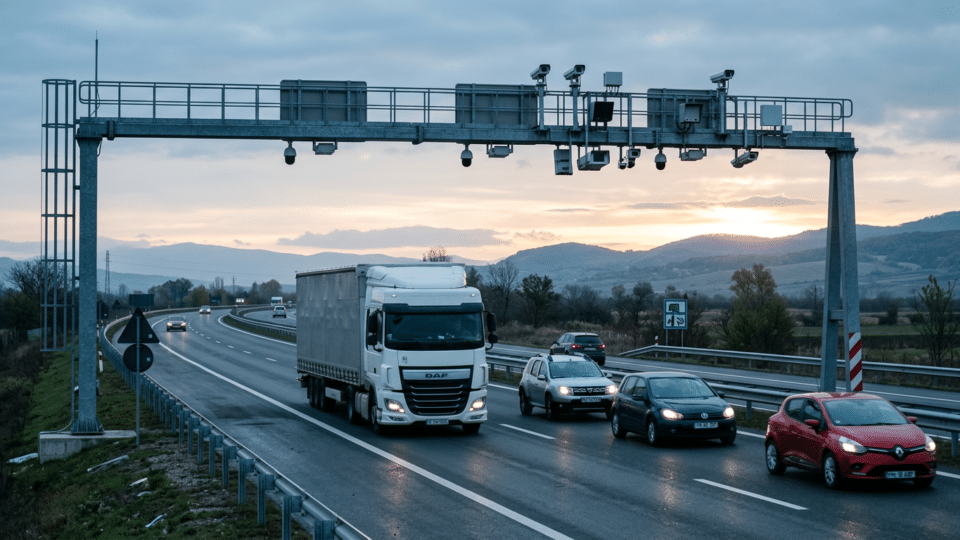
On 6 October 2026, CNAIR announced that the technical incidents identified when the TollRo platform was launched had been resolved and that the system was operating normally. Users who were unable to create an account, register a vehicle or pay TollRo because of the faults should not be penalised for that situation. However, this protection does not mean that the road becomes free of charge: the TollRo charge for the route may be determined and collected later.
For more information about CNAIR, see also The Fetești bridge toll will be removed on 1 October. What drivers will pay after the change, which provides additional details on this subject.
This is the key distinction following the disruptions when the system was launched on 1 October 2026: a fine may not apply if non-payment was caused by the system, but the obligation to pay the charge does not automatically disappear.
TollRo fines for technical problems: who is protected
According to CNAIR’s statement on the launch incidents, the protection covers users who were prevented by malfunctions from creating an account, registering their vehicle or purchasing TollRo. The company said it would not impose penalties in these cases and that the measure applies for the duration of the technical malfunction, rather than during a fixed window of several days.
It is therefore not an amnesty for every instance of non-payment. CNAIR distinguishes between a problem attributable to the platform and a situation in which the user did not attempt to use the system or entered incorrect data. The report on the announcement that the faults had been resolved also states that sporadic incidents may occur later; if they do, the protection must be assessed in relation to that specific fault, not only to the launch disruption.
In its first 12 hours of operation, CNAIR reported around 4 million visits, about 50,000 logged-in users and 170,000 vehicles, alongside problems with account confirmations, payment processing, map data and the reconciliation of certain transactions. These figures come from CNAIR’s statement published by AGERPRES; they are not the results of an independent technical audit.
| Situation | Fine | TollRo charge | What to keep |
|---|---|---|---|
| An account could not be created or a vehicle could not be registered because of a platform error | Should not be imposed, according to CNAIR | May still be due if the route and vehicle can be determined | Screenshots, the time of the error, the report submitted |
| Payment was initiated, but no confirmation was received or the ticket does not appear | Should not be imposed if the problem is linked to the malfunction | Remains due; the transaction may be reconciled | Bank statement, transaction ID, emails, screenshots |
| There is an active session or valid ticket, but the system recorded the situation incorrectly | Should not be imposed for the system fault | May be calculated later, with no additional cost indicated by CNAIR | Proof of the session/ticket and vehicle details |
| The user did not attempt payment although the system was working | Protection does not automatically follow from the announcement | Due | There is no proof of an incident that replaces the obligation to pay |
The charge remains due, even if no penalty applies
TollRo is a distance-based charge, not a fixed daily fee. Law No. 226/2023 applies it primarily to freight vehicles with a maximum authorised total weight of more than 3.5 tonnes and equivalent mixed-transport vehicles that use the Romania SETRE domain. The amount depends on distance, road category, vehicle weight and emissions class.
Law No. 226/2023, in the version available on the Legislative Portal, distinguishes between the existence of the payment obligation and the penalty regime for failing to meet it. This explains why the two can coexist in the TollRo incident: the authority may refrain from penalising non-payment caused by its own system without waiving the charge for the road travelled.
CNAIR said that for vehicles with an active session in the app or a valid route ticket, the charge may be determined later based on the available data, with no additional costs. However, the company has not published a detailed methodology showing, for each type of error, how it definitively distinguishes a technical fault from user error.
The protected period has no single publicly stated end time
The system went live on 1 October 2026 at 00:00. CNAIR announced that the incidents had been resolved on 6 October, but did not publish a technical report giving the start and end times for each affected component: accounts, maps, the payment processor or reconciliation.
For this reason, the cautious wording is that protection applies for the duration of the relevant malfunction, rather than that every journey made during a rigidly defined period is automatically exempt. CNAIR’s announcement, reported by TVR Info, also mentions the possibility of sporadic technical incidents after the main issues were resolved.
This matters especially for fleets. A carrier that encountered an error on 1 October needs documents relating to that journey. Another that encounters an error after 6 October cannot automatically invoke the launch period, but must document the new fault and report it promptly.
A four-step test for a specific case
In the absence of a complete public procedure for all types of failed transactions, a case can be assessed in practice through four questions:
- Was there a system malfunction? Record the error message, date, time and channel used: portal, app, provider or point of sale.
- Was there a genuine attempt to comply? For example, creating an account, registering a vehicle, purchasing a ticket or starting a charging session.
- Is the link between the error and non-payment plausible? A screenshot showing an error during payment has different relevance from the absence of any attempt to access the system.
- Can the vehicle and route be identified? This information may allow the charge to be calculated later, even if no penalty applies.
The UNTRR road transport organisation separately reported problems with access, account activation, payments, ticket issuance, trip recording and invoicing. Its position documents the operational impact reported by its members, but does not change the legal framework or replace the system administrator’s assessment of each case.
What to do if money was debited but the ticket does not appear
CNAIR recommends not immediately repeating the payment when confirmation has not arrived. First, check the TollRo account and the email Spam folder. If the transaction does not appear, keep the bank statement and any technical evidence, then submit a report through the platform’s contact channel.
- save the screenshot showing the error and displayed time;
- keep the confirmation email or, if it is missing, evidence that it is missing;
- record the registration number, route, date and time period of the journey;
- keep the account statement, payment identifier and report number;
- do not treat a second payment as the automatic solution before checking the first transaction.
The company said that affected transactions are being reconciled and that amounts paid will not be lost. This is not the same as immediate confirmation of every transaction: until the account reflects the situation or a response is received, the documents kept may matter in any subsequent clarification.
For context on the first day’s disruptions and payment methods, see also InfoBuz’s analysis of the problems that arose when TollRo was launched.
In short: after the faults were resolved, the normal rule of paying TollRo applies again. The exemption from a fine is conditional on a system malfunction, not on the mere existence of launch problems. For situations already affected, the charge may be determined later, and proof of an attempt to pay or register remains the most useful practical protection.
Frequently asked questions
Is TollRo cancelled for the period when the platform had problems?
No. CNAIR announced that it would not impose penalties on users prevented by faults from complying, but the TollRo charge for the route may be determined later.
Am I protected if I did not access the TollRo platform at all?
Not automatically. The protection announced by CNAIR concerns situations in which a user could not create an account, register a vehicle or pay because of a malfunction. CNAIR says it can distinguish these cases from the absence of an attempt to pay.
What should I keep if the TollRo payment was debited but the ticket does not appear?
Keep the bank statement, transaction identifier, screenshots, emails and journey details. CNAIR recommends checking the account and Spam folder before repeating the payment, then submitting a report.
Sources consulted
- CNAIR — statement on the operation of the TollRo platform and launch incidents, published by AGERPRES
- Law No. 226/2023 on the application of certain road charges on Romania’s national road network — Legislative Portal
- TVR Info — TollRo platform technical incidents have been resolved, CNAIR announces
- UNTRR — TollRo blocks road transport and affects the functioning of Romania’s economy


Discuția cititorilor
Ai o opinie sau o întrebare despre acest articol? Spune-ne ce crezi.
Fii primul care deschide discuția.
Te rugăm să păstrezi un limbaj civilizat și să discuți la subiect. Comentariile spam sunt filtrate automat.