
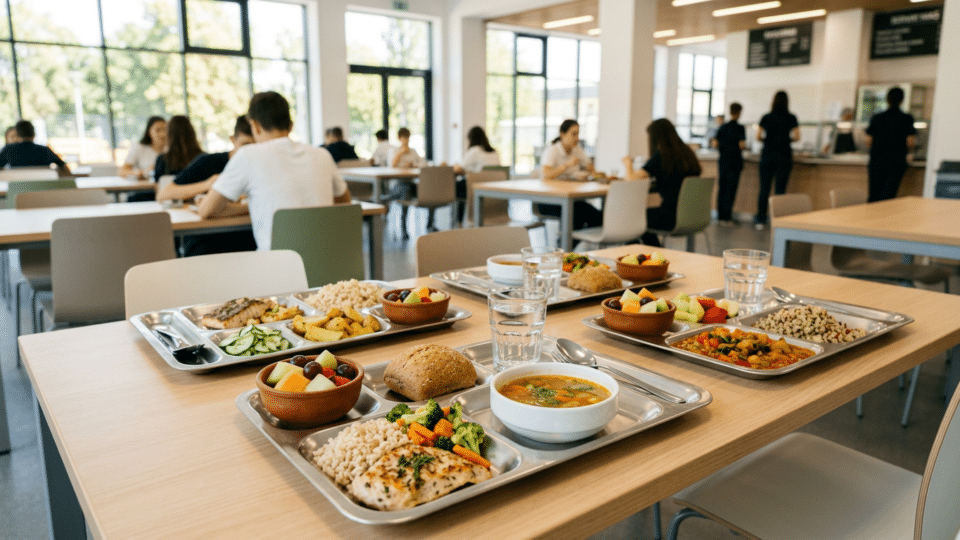
In 2025, the rules for school food moved beyond the simple formula of “no soft drinks and sweets”. Ministry of Health Order No. 541/2025, updated by Order No. 1,582/2025, draws a clearer distinction between products not recommended for sale on school premises and the way menus offered to children are put together. It also places emphasis on documentation: labels, composition information, menus, recipe books and dietary surveys.
The distinction matters to parents. A sugary drink may be an issue at a school kiosk. An unbalanced menu, an unsuitable portion or the absence of food samples are different issues, however, and may arise in a cafeteria or through catering. Nor is a packaged product automatically non-compliant: its composition, label, product category and the context in which it is offered all matter.
For more information about the Ministry of Health, see also Dietary supplements: how to read the label before buying vitamins, magnesium or “immunity” products, which provides complementary details on this topic.
The consolidated version of Order No. 541/2025 is the reference document. Amending Order No. 1,582 was issued on 18 November 2025 and published in Official Gazette No. 1101 of 28 November 2025.
Two different rules: what is sold and what is served
The most useful distinction is between sales and the collective menu.
- Sales refer to products sold on the premises, for example at a kiosk, vending machine or point of sale. The order contains a list of foods not recommended for this purpose.
- Serving food as part of a menu refers to meals prepared in the school kitchen or delivered through catering. Here, the rules address the frequency of food groups, portions, nutrient intake, water and menu documentation over several days.
In the menu annexes, foods are grouped into categories such as “to be served most often”, “to be served occasionally” and “not recommended to be served”. These do not operate in the same way as the list of products not recommended for sale. For example, a food may not be suitable as a frequent choice in a collective menu without the text saying that it is illegal for a child in every context outside school.
Therefore, the phrase “foods banned in schools” is too broad and may be misleading. The documents use categories with different effects.
What can be checked on the label of a product sold at school
The list attached to Order No. 541/2025 includes nutritional thresholds for products sold on the premises of educational institutions. In the order’s original version, these covered, among other things, products with more than 15 grams of sugars per 100 grams, more than 1.5 grams of salt per 100 grams or the equivalent of 0.6 grams of sodium, as well as those exceeding 300 kcal per sales unit. There are also criteria relating to fats, saturated fats and trans fatty acids.
The order also lists categories such as soft drinks, energy drinks, sports drinks and instant hot drinks. The exact application depends on the product category and the exceptions set out in the annex; therefore, a parent should not draw a conclusion based solely on the appearance of the packaging.
A realistic check, without rushing to conclusions
If a product is sold at school, useful information to retain includes a photograph of the front of the package, the nutrition table, the ingredient list, the product’s commercial name, the date and the institution where it was observed. A photograph of the label is more useful than a report that “sweets are being sold”, because it makes it possible to check the thresholds and the product’s classification.
The November 2025 amendment specified that operators must comply with legislation on labelling and correct consumer information. This does not turn every lack of clarity on packaging into an already proven breach, but it shows why the label and composition data are essential for inspections.
The food’s journey: four situations, four sets of evidence
| Where the food is provided | What is checked primarily | Useful documents | Who has a direct role |
|---|---|---|---|
| Kiosk or point of sale | Product category, composition, nutritional thresholds, labelling | Label, product specification, photograph of the package | The commercial operator; health authorities during inspections |
| Cafeteria with its own food-service facility | Menu, portions, recipe book, hygiene, food samples | Menu, food records, recipe books, dietary-survey documentation | The institution’s management, staff involved in food service and, where applicable, medical staff |
| Catering | Menu, delivery, storage, portion weight, allergens and samples | Weekly menu, delivery documents, allergen information, food samples | The catering company and the institution receiving the products |
| Public food programme | Programme-specific rules, receipt and storage of products | Receipt and delivery documents, labels, storage conditions | The supplier, the school and the local authorities involved |
The table shows why the same question—“is the food at school good?”—does not have a single administrative answer. For a drink sold at a kiosk, the label is the first thing to read. For a hot meal, the label of one ingredient is not enough: the menu, portion, recipe book, transport and storage conditions also matter.
School food: what changed after the November 2025 update
Order No. 1,582/2025 did not merely introduce new wording on labels. The updated version also clarifies the framework for inspections and responsibility.
- Composition must be supported by correct consumer information. In practice, the label and product documents become central when a product being sold is checked.
- Penalties are explicitly mentioned. Article 71 provides that non-compliance with the order is established and administratively sanctioned by authorised staff of the public health directorates and the State Health Inspection.
- Menus are assessed over a period, rather than as a single tray. To assess the average quantity and quality of food consumed, the order provides for analysis of food records, nutrition labels or menus served over 10 working days, together with recipe books in the specified circumstances.
- Roles differ according to the supply model. In institutions with their own food-service facilities, medical staff have duties under the applicable rules. In institutions without their own food-service facilities, the catering company sets the weekly menu together with the institution’s management and carries out the dietary survey in accordance with the applicable rules.
It is important not to attribute all these obligations solely to Order No. 541/2025. Requirements on hygiene, transport, allergens, sample retention and catering must also be read through the rules in Order No. 1,456/2020.
What the September 2025 inspections found
The Ministry of Health report on inspections conducted between 8 and 30 September 2025 provides a picture of implementation on the ground, but it does not yet measure the full effect of the version amended at the end of November.
According to the State Health Inspection report, 2,727 educational institutions were inspected. A total of 419 administrative sanctions were imposed: 298 warnings and 121 fines, with total fines amounting to 533,200 lei.
At commercial outlets on school premises, inspectors checked 1,028 products and classified 625 as not recommended for children. The figure must be read correctly: it refers to products selected during that inspection, in that period. It does not show how many children consumed the products and cannot be converted into a percentage of all food sold in Romanian schools.
The report also records issues not limited to sugar or salt: five improperly prepared menus in 406 inspected food-service facilities, seven institutions where food samples were not retained, and situations involving single-use containers in institutions supplied through catering. These findings explain why compliance cannot be reduced to the “healthy product” on the label.
What a parent can do when they notice a possible irregularity
The first useful step is to identify the type of issue, rather than automatically choosing a single institution for every situation.
- For a product sold at school: keep clear photographs of the label, the product name, date and place. A report may be submitted to the school management and to the county public health directorate or the Bucharest Public Health Directorate, which has health inspection duties.
- For a meal provided by a cafeteria or through catering: note the day, menu, portion, and any issues with temperature, appearance, smell or packaging, and first ask the institution for clarification. If there is a concern about hygiene or food safety, responsibility may involve the public health directorate and, depending on the product and circumstances, the County Sanitary Veterinary and Food Safety Directorate (DSVSA).
- For consumer information: missing relevant information, including on labelling or allergens where applicable, may require a report to the authority competent for that type of breach, including the National Authority for Consumer Protection (ANPC) in situations falling within consumer protection.
A useful report describes observable facts; it does not determine the penalty on its own: “product X was offered for sale on date Y, and the label stated Z” is more verifiable than “the school offers unhealthy food”. If a child develops symptoms after consuming food, medical assessment is the priority; the parent should follow medical advice and promptly inform the institution.
Public programmes are not the same as a kiosk
The National “Healthy Meal” Programme provides, during the school term, a free hot meal or, when a hot meal cannot be provided, a food package. The methods of provision—self-preparation or catering—are separately regulated by Government Decision No. 23/2025.
Separately, Romania’s School Scheme has its own rules for distributed products. It is therefore not correct to automatically apply a rule applicable to a kiosk to a product distributed through a public programme. At the same time, being offered through a programme does not exempt a product from applicable requirements on composition, receipt, storage and food safety.
The 2025 rules therefore create a standard that is easier to follow, but they do not by themselves guarantee the quality of every meal. Responsibility remains shared among the supplier, school, responsible staff and inspection authorities. For parents, the useful question is not only “what is my child not allowed to eat?”, but also “what document is this offering based on, and who can check it?”
Frequently asked questions
Are all sweets and soft drinks banned in schools?
No. The order uses a list of foods not recommended for sale on institutional premises and composition thresholds, but the rules for collective menus are different. Classification depends on the product, label, category and how it is offered.
Is a packaged product automatically allowed at a school kiosk?
No. Packaging helps verify composition and consumer information, but the product must also meet the criteria applicable to sales. Conversely, a packaged product is not automatically non-compliant merely because it is packaged.
Who sets the menu when a school receives food through catering?
Under the updated version of the order, the catering company sets the weekly menu together with the educational institution’s management and carries out the dietary survey in accordance with the applicable rules. Hygiene, transport and food-sample requirements are also regulated by the relevant health rules.
What evidence should a parent keep for a report?
A photograph of the label or product, the date, place, product name and displayed menu, where available, are useful; for catering, any available delivery documents may also be useful. Describe observable facts and avoid assuming the cause or penalty in advance.
Sources consulted
- Order No. 541/2025 approving the List of Foods Not Recommended for Preschool and School-Age Children and the Principles Underlying Healthy Nutrition for Children and Adolescents, consolidated version
- Order No. 1,582 of 18 November 2025 amending and supplementing Order No. 541/2025
- State Health Inspection report on inspections in educational institutions, 8–30 September 2025
- Order No. 1,456/2020 approving Hygiene Rules for Institutions Providing Care, Education, Training, Rest and Recreation for Children and Young People
- Government Decision No. 23/2025 establishing the National Healthy Meal Programme


Discuția cititorilor
Ai o opinie sau o întrebare despre acest articol? Spune-ne ce crezi.
Fii primul care deschide discuția.
Te rugăm să păstrezi un limbaj civilizat și să discuți la subiect. Comentariile spam sunt filtrate automat.