
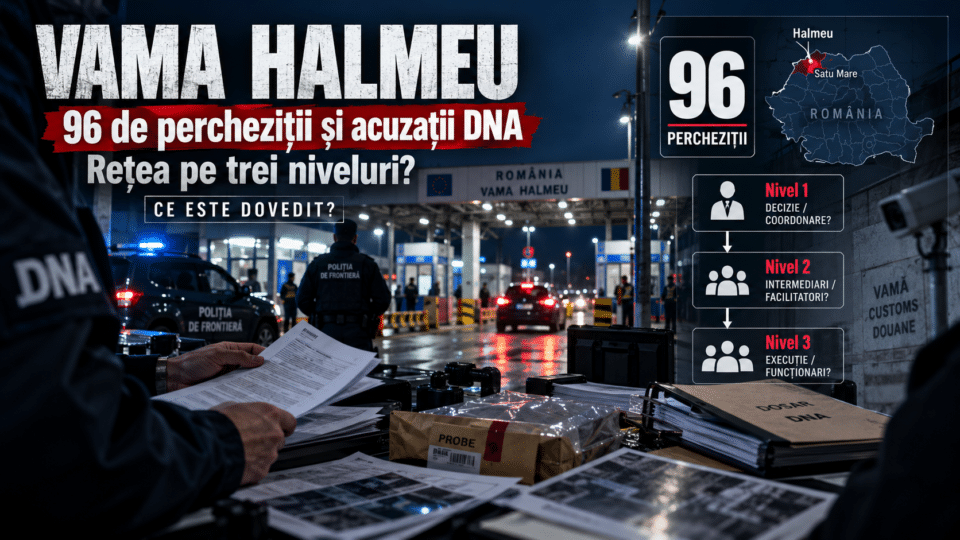
The Halmeu border inquiry, opened by prosecutors from Romania’s National Anti-Corruption Directorate (DNA), has brought serious allegations over how checks may have operated at the border between Romania and Ukraine. In statements issued on 5 and 6 October 2026, DNA announced 96 searches, the initiation of criminal proceedings against nine defendants, and the extension of the criminal investigation to another 38 people. Prosecutors describe the alleged operation of an organised group with three tiers, in which sums of money were allegedly collected and distributed in exchange for the performance or non-performance of official duties.
These facts are presented solely as investigators’ suspicions and allegations. No person named in this article is presented as guilty in the absence of a final court ruling. Nor can sums found during searches automatically be regarded as proven bribes. The purpose of this article is to explain what the official documents indicate and what remains unclear, not to reach a verdict before the courts do.
The Halmeu border inquiry: what DNA officially announced
On 5 October 2026, DNA Oradea announced searches at 96 locations in the counties of Satu Mare, Bihor, Sălaj, Maramureș, Cluj and Mureș. The searches targeted the premises of public institutions and the homes of people under investigation. The statement referred to suspected acts committed in 2025–2026 in connection with checks at the Halmeu border crossing point.
The following day, 6 October, prosecutors detailed the allegations and the factual scenario they say emerges from the evidence gathered. Two people in leadership positions were publicly named: Babici Adiel Viorel, head of the Halmeu Border Police Sector, and Kis Mihai, head of the Halmeu Border Customs Office. According to the DNA statement, both were charged in connection with allegations of forming an organised criminal group and taking bribes on a continuing basis.
DNA said that other people in the border police and customs administration have the procedural status of defendants or suspects, depending on the role under investigation. Procedural status is not proof of guilt. It establishes the framework in which investigators may gather evidence and in which those concerned may exercise their rights, including the right to a defence.
How the network described by prosecutors allegedly operated
In its 6 October statement, DNA says the group may have been formed as early as 2022, amid increased road traffic and shipments of parcels and luggage from Ukraine into the European Union. Investigators claim the structure had three tiers.
At the first level were allegedly the leaderships of two control structures, which prosecutors say coordinated activity and kept trusted people in positions organising shifts. The second level allegedly consisted of intermediaries and shift coordinators who collected and divided the money. The third level allegedly included staff carrying out direct checks on vehicles and people.
This mechanism is the prosecution’s factual theory. It must be proved in judicial proceedings in relation to each person and each alleged act. The real administrative roles of the people under investigation do not, by themselves, prove participation in any criminal group.
“Fees” at the border crossing: what the DNA document alleges
According to prosecutors, some sums were allegedly requested or received from drivers in connection with how checks were carried out, administrative offences were sanctioned, or other official duties were performed. DNA says the alleged sums charged to drivers ranged, in the situations documented by the investigation, from €50 to €1,900 or the equivalent.
In the customs area, investigators allege that people in intermediary roles collected about 25% of sums received by subordinates on some shifts, and that part of the money was passed on. The percentage is not a legal rate, an official charge, or an independently verified indicator of activity across the entire border crossing. It is an element of the prosecution’s scenario.
Such an alleged scheme would be serious not only because it could generate illicit income, but because it could affect the impartial application of procedures. Border checks must depend on documents, the status of goods and the regulations in force, not payments to officials. That is precisely why the distinction between an allegation and a proven act is essential to the credibility of the information.
Sums described in the 6 October statement
DNA states that, between 16 October 2025 and 24 May 2026, one of the managers under investigation allegedly repeatedly received US$6,450, €2,750 and other undue sums or benefits. Prosecutors also describe an alleged request for €4,000 per month from a subordinate. For the other manager, the statement gives an example of the alleged receipt of €800 on two occasions, between 27 August and 4 September 2026.
These figures are explicit examples of the allegations, not a final court-established account of criminal offences. They should not be added up indiscriminately and presented as the total value of the alleged network, because the document also describes other sums, currencies and situations. Any verification of transactions, the origin of the money and its link to the performance of duties are matters for the criminal investigation.
The more than €300,000 found in searches: what it means and does not mean
Prosecutors say that sums totalling more than €300,000 or the equivalent were found and seized at the homes of defendants and suspects. This finding describes assets seized for further investigation; it does not prove that every euro came from bribes. The lawful or unlawful origin of the sums must be established for each situation on the basis of evidence.
This is where one of the most common reporting errors in a criminal case arises: treating seized money as equivalent to proven damage or unlawfully appropriated money. These are distinct legal and accounting categories. Seizing assets allows them to be examined, but does not replace a court’s ruling on confiscation or guilt.
Detention and a request for remand are not convictions
DNA announced the 24-hour detention of nine defendants, beginning on 5 October. According to the statement, eight were to be brought before Bihor Tribunal with a request for 30 days of pre-trial detention. This is the information verified in the 6 October document; no later court decision is attributed to the court without consulting its ruling.
Detention, pre-trial detention, judicial supervision and conviction are distinct measures with different purposes and criteria. Preventive measures do not prove that an alleged act has been definitively established. The defence may challenge the allegations and present its own evidence, while criminal proceedings are subject to judicial review.
This article does not contain individual views requested from the people concerned; the public documents consulted do not include a detailed response from each defence. We therefore report the allegations expressly attributed to prosecutors and do not state that they have already been conclusively proved.
Why Halmeu is a sensitive crossing
Halmeu lies on routes between Romania and Ukraine, at an external border of the European Union. Since the outbreak of the war in Ukraine, road transport and the flows of people and goods have changed substantially in the region. An increase in crossings can put pressure on control capacity, staff and infrastructure.
But heavy traffic does not prove corruption. Assessing possible vulnerabilities requires an examination of shift organisation, post rotation, internal checks, reports, the operation of surveillance systems and the recording of administrative decisions. A corruption investigation raises questions about these mechanisms without proving that all employees of an institution broke the law.
What questions of public interest remain unanswered
First, what exact period and scale of alleged acts will be capable of proof? The statement indicates that the alleged structure was formed in 2022, while some specific acts are described for 2025–2026. Second, what internal-control mechanisms existed and why did they not prevent the alleged misconduct, if it is confirmed?
Third, what is the origin of the seized sums and what proportion can be linked to offences through evidence? Fourth, what administrative measures are being applied to maintain lawful checks and transport operators’ rights? Fifth, what does each defendant’s defence say, should it wish to respond publicly to the allegations?
These questions are not conclusions and should not be treated as additional allegations. They identify legitimate avenues for further reporting, based on court rulings, public data and responses from the institutions involved.
What a driver can do if asked for an unjustified payment
Official payments at the border must be provided for by law and documented through verifiable procedures. If a person is asked for an unjustified payment, they should not mistake that request for a lawful charge without checking the basis for it. It is useful to retain travel documents and information about the date and place of the event and, in accordance with the law, submit a report to the competent authorities.
DNA provides public information on reporting corruption offences. A statement or complaint should describe specific facts, not fabricated allegations or speculation. Protection for those who report and the integrity of the procedure are as important as sanctioning proven acts.
What comes next in the Halmeu case
The next stages may include the gathering of evidence, hearings, expert examinations, prosecutorial decisions and, if charges are brought before a court, the examination of the allegations in court. Different people may receive different outcomes depending on the individual acts and evidence. Not everyone investigated in a joint case necessarily reaches the same judicial outcome.
The public interest justifies close scrutiny of the case, but not prejudging guilt. Accurate reporting will be updated only following new verifiable documents: court rulings, procedural statements and official positions from the parties.
Frequently asked questions
How many searches did DNA announce?
96 locations, according to the statement of 5 October 2026.
Have 47 people been convicted?
No. DNA announced nine defendants in connection with the measures announced and another 38 people under criminal investigation as suspects; the statement itself does not amount to a final conviction.
What does the seized money represent?
Sums found during searches that are being investigated to establish their origin; they are not automatically proven bribes.
Does the case target the entire Border Police?
No. The allegations concern specific people and specific acts, not all employees of an institution.
Why a prosecutors’ statement cannot be confused with an indictment
A press statement summarises information prosecutors consider they can make public at a stage of an investigation. It does not reproduce in full the statements, recordings, financial documents or defence arguments. Nor does the statement’s chronology necessarily match the entire procedural timetable. A complete account would require judicial documents that become public under the law, as well as any positions taken by the parties.
An investigation may involve differently framed suspicions concerning different people, and the number of suspects may change. Some acts may be sent to trial, while others may receive different outcomes. For this reason, it is incorrect to divide the €300,000 found during searches arbitrarily among individuals or turn it into a presumption about the entire institution.
What institutional accountability means without collective guilt
In border administration, transparent shift scheduling, procedural checks and reporting mechanisms can reduce vulnerabilities. These principles matter regardless of the judicial outcome in a specific case. However, the fact that an institution needs better internal controls does not prove that every employee received undue payments.
The public has a right to know which prevention measures have been implemented and whether control activity is operating under normal conditions. Administrative information must nevertheless be assessed separately from criminal allegations against individuals.
To understand why documents and the procedural stage matter, also read InfoBuz’s analysis of situations in which official documents from the same institution appear to contradict one another. The article explains general verification methods and is not evidence in the Halmeu case.
Documents consulted and limits of verification
- DNA – 5 October 2026, No. 658/I-36: the searches and the subject of the investigation.
- DNA – 6 October 2026, No. 662/I-36: description of the allegations, measures and sums identified.
- National Anti-Corruption Directorate – statements and information on the rights of people under investigation.
InfoBuz research: 9 October 2026. Analysis of documents published by the prosecution, not an independent on-the-ground investigation. The named individuals benefit from the presumption of innocence. We do not attribute guilt, final damage amounts or rulings that have not been consulted.


Discuția cititorilor
Ai o opinie sau o întrebare despre acest articol? Spune-ne ce crezi.
Fii primul care deschide discuția.
Te rugăm să păstrezi un limbaj civilizat și să discuți la subiect. Comentariile spam sunt filtrate automat.