
Updated: 8 October 2026 la 18:28. Articolul a fost revizuit pentru a reflecta informațiile disponibile la această dată.
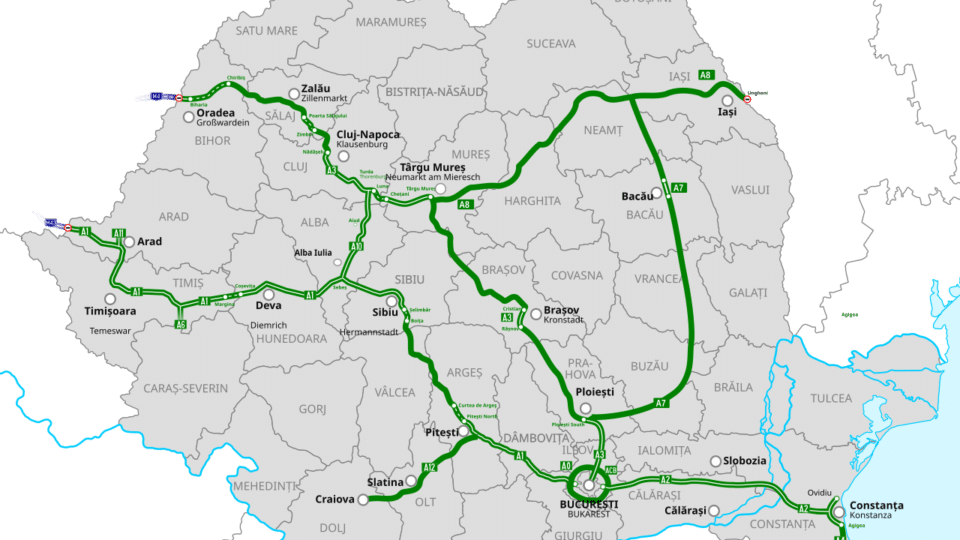
Romania is entering a period in which its road map could change more than it has in the past two decades. The A0, A1, A7, A8, A13 and new expressways are not merely lines on a map: they could change travel times, freight routes, access to investment and even the appeal of entire cities.
However, the 2030 outlook must be viewed realistically. Some projects are already under construction or have clear funding, others have been contracted, while some remain in the design phase or depend on future procedures and budgets. This article therefore distinguishes between what is concrete and what remains a target for now.
Romania’s roads in 2030: what could genuinely change
Official investment plans include the completion and expansion of several TEN-T corridors and links between Moldavia, Transylvania, Muntenia and the west of the country. The National Recovery and Resilience Plan (PNRR) explicitly included 429 km of new road infrastructure on the TEN-T network, including the A7 Ploiești–Pașcani, two sections of the A8, Margina–Holdea on the A1 and Nădășelu–Poarta Sălajului on the A3.
A7: Moldavia’s road backbone
The A7 Ploiești–Pașcani is one of Romania’s most important infrastructure projects. The corridor links Muntenia with Moldavia and maintains the prospect of a connection towards Suceava and Siret.
The A7’s real impact is not limited to shorter travel times to Bucharest. The motorway could reshape regional logistics for Buzău, Focșani, Bacău, Roman and Pașcani, and could make industrial areas that have until now been disadvantaged by slow road access far more attractive.
A8: the motorway that could link Moldavia to Transylvania
The A8 Târgu Mureș–Târgu Neamț–Iași–Ungheni is the project that could most radically reshape Romania’s east–west connections. Two sections were included in the PNRR: Târgu Mureș–Miercurea Nirajului and Leghin–Târgu Neamț.
In the long term, completing the corridor would create a fast link between Iași, the Târgu Neamț area and Transylvania’s motorway network. For the economy, this means faster access to western Romania and European networks. For hauliers, it means a far more efficient alternative to current routes along national roads and through mountain passes.
A1 Sibiu–Pitești: the missing link between Bucharest and the west
The Sibiu–Pitești motorway is essential to the continuity of the A1 between Bucharest and western Romania. The mountain sections are among Romania’s most difficult road infrastructure projects, involving tunnels, viaducts and complex works.
For additional information, readers can also consult The solar eclipse of 12 August 2026 visible from Romania: exact time, map, scientific explanations and a complete viewing guide, an article that explores an aspect directly related to this subject.
Once the corridor is complete, the Bucharest–Sibiu–Nădlac route will be able to operate as a continuous high-speed axis. The effect will be significant for freight transport and the automotive industry: more predictable journey times, fewer journeys through towns and villages, and a more direct connection between southern Romania and the western border.
Margina–Holdea: 9 kilometres that blocked A1 continuity for years
The Margina–Holdea section is short but strategic. It is the missing link needed to ensure the continuity of the A1 motorway in the west, and includes difficult works, including tunnels.
The PNRR included this sector among the projects that must be completed, precisely because its value far exceeds its roughly 9 kilometres: it removes one of the best-known breaks in the fast route between western and central Romania.
A0: the ring road that could completely reshape Bucharest traffic
The A0 motorway is more than a ring road. It is conceived as a complete high-speed ring around Bucharest and could take on through traffic that currently puts pressure on the Bucharest Ring Road (DNCB) and on routes into the capital.
A complete A0 could redistribute flows between the A1, A2, A3 and major national roads without crossing congested urban areas. For logistics, warehouses and industrial parks, this means faster access between the main corridors and a new geography of investment around the capital.
A13 Brașov–Bacău: a direct link between central Romania and Moldavia
The A13 Brașov–Bacău remains a project with high strategic potential. Official documents from 2026 retain the project in action plans and indicate a development horizon towards the end of the decade.
If it progresses in line with its design and funding stages, the A13 could create a direct connection between Brașov and Bacău and could complement the A8 and A7. However, its timetable should be treated more cautiously than those of sections already under construction.
A3 and Transylvania’s connections
The Transylvania Motorway continues to be completed through sections such as Nădășelu–Poarta Sălajului and other lots intended to link Cluj, Oradea and north-western areas more efficiently.
A more coherent A3 network could reduce pressure on national roads in the north-west and better integrate Cluj, Oradea and logistics centres near the western border.
Expressways are becoming the network’s second tier
Change will not come from motorways alone. Expressways could become the link between major corridors and cities that do not lie directly on them. Craiova–Pitești has already shown how important a fast connection can be for industry and regional traffic.
Projects such as Brăila–Galați and other fast connections could turn cities that are currently relatively isolated from the motorway network into far more competitive hubs.
Who could benefit most by 2030
- Iași and north-eastern Moldavia — through the A7 and, gradually, the A8;
- Bacău — positioned between the A7 and the future prospect of the A13;
- Sibiu and Pitești — through A1 continuity;
- Bucharest and Ilfov — through the A0 and the distribution of traffic between major corridors;
- Cluj and Oradea — through completion of the A3;
- Craiova — through its fast connection with Pitești and the A1;
- Brăila and Galați — through the bridge, expressways and new logistics connections.
How travel times are changing
The greatest benefit is not maximum speed but predictability. A motorway route avoids towns and villages, traffic lights, pedestrian crossings, risky overtaking and repeated bottlenecks. Even when the theoretical difference in journey time does not seem dramatic, the difference in consistency can be enormous for hauliers and commuters.
On long corridors, the effects add up. A continuous Bucharest–Sibiu–Nădlac network, a functioning A7 towards Moldavia and an east–west connection via the A8 would completely change how a 400–600 km journey through Romania is planned.
Motorways also change land prices
New infrastructure can increase the attractiveness of land near motorway interchanges, but not every plot “near a motorway” automatically becomes valuable. What matters is actual access through an interchange, utilities, planning regulations and proximity to the workforce.
Warehouses, logistics parks, services, petrol stations, hotels and new industrial areas may emerge around major interchanges. By contrast, localities bypassed by through traffic may lose some roadside commercial activity, but can gain peace and quiet, safety and space for urban development.
2030 is not a magic date
It is important not to turn a map of projects into a map of promises. Major infrastructure depends on expropriations, permits, legal challenges, design, funding, geological conditions and the pace of contractors.
Some sections may be completed ahead of schedule, while others may be delayed. A realistic picture of Romania in 2030 must therefore combine sections already under construction with projects that have a genuine chance of advancing over the coming years.
Conclusion: Romania could enter a new phase of mobility
If the major corridors progress in line with current schedules, Romania could reach the end of the decade with a far more coherent road network than it has today. The A7 could transform Moldavia, the A8 could open an east–west axis, the A1 could become continuous between Bucharest and the western border, and the A0 could remove a significant share of through traffic from around the capital.
The real change will not be visible only on the motorway map. It will be seen in transport times, investment, land prices and in the cities that will become more accessible than they are today.
Sources and methodology: The National Recovery and Resilience Plan, Romanian Government budget and investment documents, and official documents on road infrastructure and transport planning. Project schedules are indicative and may change depending on construction progress, funding and procedures.


Discuția cititorilor
Ai o opinie sau o întrebare despre acest articol? Spune-ne ce crezi.
Fii primul care deschide discuția.
Te rugăm să păstrezi un limbaj civilizat și să discuți la subiect. Comentariile spam sunt filtrate automat.