
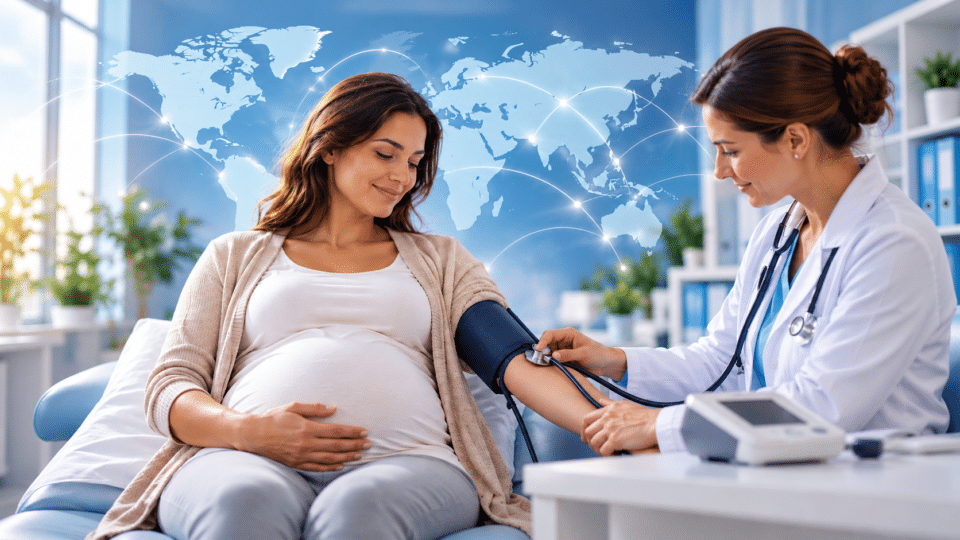
On 8 October 2026, the World Health Organization announced the launch of a global roadmap for hypertensive disorders of pregnancy. The document covers 2026–2035 and beyond. It is not a new treatment, it is not a Romanian clinical protocol, and it does not automatically change the care available at a maternity hospital in Romania. However, it is an important signal about what needs to work together to prevent serious complications: detection, assessment, referral, treatment indicated by the medical team, and follow-up after birth.
WHO estimates that hypertensive disorders complicate around 10–15% of pregnancies worldwide. In its launch announcement, the organisation links them to about 16% of global maternal deaths. A systematic analysis published in The Lancet Global Health estimated the same 16% share for 2009–2020, with an uncertainty interval of 14–19%. These figures are global: they cannot automatically be applied to Romania.
Hypertension in pregnancy: what WHO has actually launched
The WHO roadmap is a strategic framework for action, not a prescription for an individual patient and not a new legal obligation for Romanian hospitals. It organises the response around five areas: research and innovation; norms and standards; access to medical products; implementation; and advocacy and accountability.
In terms familiar to a pregnant person attending a check-up, these areas mean something simpler: blood pressure must be measured correctly, a concerning reading must be interpreted in context, the appropriate tests and service must be accessible, and referral to specialist care must not come too late.
WHO says delays can occur for several reasons: a lack of reliable blood pressure measurement, limited access to assessments such as urine protein testing, unavailable essential medicines, too few trained staff, or referral systems and emergency obstetric care that do not work coherently. These are problems identified globally; the WHO announcement is not an assessment of every maternity hospital in Romania.
Why a single reading does not establish a diagnosis
The “dangerous blood pressure” in the headline is a journalistic term for a group of conditions that are not the same. Gestational hypertension, pre-eclampsia and eclampsia have different definitions and risks. Pre-eclampsia generally occurs after 20 weeks of pregnancy and can affect several organs; eclampsia is a severe complication involving seizures.
An isolated reading, whether taken at home or in a clinic, does not by itself establish a diagnosis. A doctor interprets it alongside repeat measurements, symptoms, medical history, gestational age, relevant tests and the condition of the fetus. This is why blood pressure monitoring is essential, but it is only the first link in the chain.
Home measurement can complement check-ups when recommended by the team overseeing the pregnancy, but it does not replace them. For general measurement technique, including resting before testing and correct positioning, InfoBuz’s guide to measuring blood pressure correctly at home may be useful. During pregnancy, any unusual result should be discussed with the doctor or maternity hospital overseeing the case, rather than interpreted alone using thresholds found online.
Five links between prenatal care and safe care
The practical value of the WHO plan is easier to see as a pathway than as a list of international objectives.
| Link | What needs to happen | What the patient can ask at a check-up |
|---|---|---|
| Measurement | Blood pressure is checked correctly and recorded at prenatal contacts. | “How and when should I monitor my blood pressure between check-ups, if necessary?” |
| Assessment | A raised reading is assessed in the context of symptoms, tests and the progression of the pregnancy. | “What does my result mean, and what further checks are needed?” |
| Referral | There is a clear decision about who takes over the case and where to go if the risk increases. | “Which maternity hospital or service should I go to if problems arise?” |
| Intervention | The medical team determines the monitoring and treatment appropriate to the clinical situation. | “What signs should make me call immediately, and which number should I use?” |
| Postpartum | Care does not automatically stop at birth; it is determined whether further follow-up is needed. | “When should my blood pressure be checked after birth, and who will follow up the results?” |
These questions do not replace a medical consultation. Their role is to clarify the pathway, particularly if the pregnant person lives far from a maternity hospital, has other illnesses or experienced blood pressure problems in a previous pregnancy.
What the data from Romania show — and what they cannot prove
Romania should not be described using the global figure of 16%. The available local data in the sources consulted have different coverage and limitations. A report by the National Institute for Mother and Child Health (INSMC), analysing 2000–2019, records 413 deaths from direct obstetric risk; 67 were classified as oedema, proteinuria and hypertension in pregnancy, childbirth and the puerperium. This is a historical series, not a statistic for 2024, 2025 or 2026.
The report also notes that the relatively small annual number of deaths limits detailed year-by-year statistical analysis by cause. It is therefore not correct to turn this information into a current estimate of how many deaths are caused annually in Romania by pre-eclampsia or eclampsia.
Another INSMC study, based on 36 maternal deaths and 53 near-miss cases — very severe situations in which the patient survived — found severe pre-eclampsia and eclampsia among the important conditions identified on admission in these groups. This supports the idea that severity at presentation matters. However, it does not say how common these complications are across all pregnancies in Romania, nor can it automatically attribute delays to a single cause.
A study conducted in three Romanian obstetric centres analysed 104 patients with pre-eclampsia, including 23 with eclampsia. The results illustrate how severe eclampsia can become in cases treated at tertiary hospitals, but they do not represent nationwide prevalence. This difference between a severe clinical cohort and the general population is essential to reading medical data correctly.
Signs requiring prompt medical assessment
Pre-eclampsia may initially cause no obvious symptoms, which is why regular prenatal check-ups matter. At the same time, symptoms such as a severe or persistent headache, visual disturbances, severe pain in the upper abdomen, sudden shortness of breath, feeling very unwell, or swelling that appears suddenly should be promptly reported to the doctor or maternity hospital overseeing the pregnancy.
If seizures, loss of consciousness, significant breathing difficulties, severe chest pain or other emergency signs occur, call 112. Do not drive yourself to hospital and do not attempt to manage the situation at home with medicines taken without medical advice. These signs do not by themselves confirm pre-eclampsia, but they require urgent assessment.
After birth: why the pathway does not automatically end
The WHO plan also includes continuity of care after birth. This does not mean that everyone who had high blood pressure during pregnancy will develop cardiovascular or kidney disease. It means that this history should be discussed at the postpartum check-up and included in subsequent medical care, so that the doctor can recommend monitoring appropriate to each person.
For more information about hypertension, see also Dementia prevention goes beyond lifestyle: what the 2026 WHO guideline changes, which provides complementary details on this topic.
The global plan will matter in Romania only if it is followed by verifiable measures: better access to check-ups, trained staff, available equipment and medicines, functioning transfer pathways, and clearer data on outcomes. For a pregnant person, the concrete step now is closer at hand: regular check-ups, clear questions about where and when to seek help, and a prompt response to changing symptoms.
Frequently asked questions
Is the WHO plan a new treatment for pre-eclampsia?
No. The WHO roadmap is a global strategic framework for research, standards, access, implementation and accountability. It is not a new treatment and does not replace an individual medical assessment.
Does one high blood pressure reading at home mean pre-eclampsia?
Not necessarily. A single measurement does not establish a diagnosis. During pregnancy, the result should be discussed with the doctor or maternity hospital overseeing the case, particularly if it recurs or worrying symptoms appear.
Why is a check-up after birth important if the problem occurred during pregnancy?
Hypertensive disorders may require monitoring after birth as well. The medical team can determine when blood pressure should be checked and whether further follow-up is needed, depending on how each case develops.
Sources consulted
- WHO — Global roadmap for hypertensive disorders of pregnancy from 2026 to 2035 and beyond
- WHO — New global roadmap launched to tackle hypertension in pregnancy, a leading cause of maternal and newborn deaths
- The Lancet Global Health — Global and regional causes of maternal deaths 2009–20: a WHO systematic analysis
- INSMC — Report on young child health and reproductive health
- Journal of Clinical Medicine — Factors Associated with Maternal Morbidity in Patients with Eclampsia in Three Obstetric Intensive Care Units


Discuția cititorilor
Ai o opinie sau o întrebare despre acest articol? Spune-ne ce crezi.
Fii primul care deschide discuția.
Te rugăm să păstrezi un limbaj civilizat și să discuți la subiect. Comentariile spam sunt filtrate automat.